On January 31, 2026, at the Stand Up To Cancer Innovation Summit, I presented three recommendations intended not as incremental adjustments, but as structural corrections to a system that has tolerated delay for far too long .
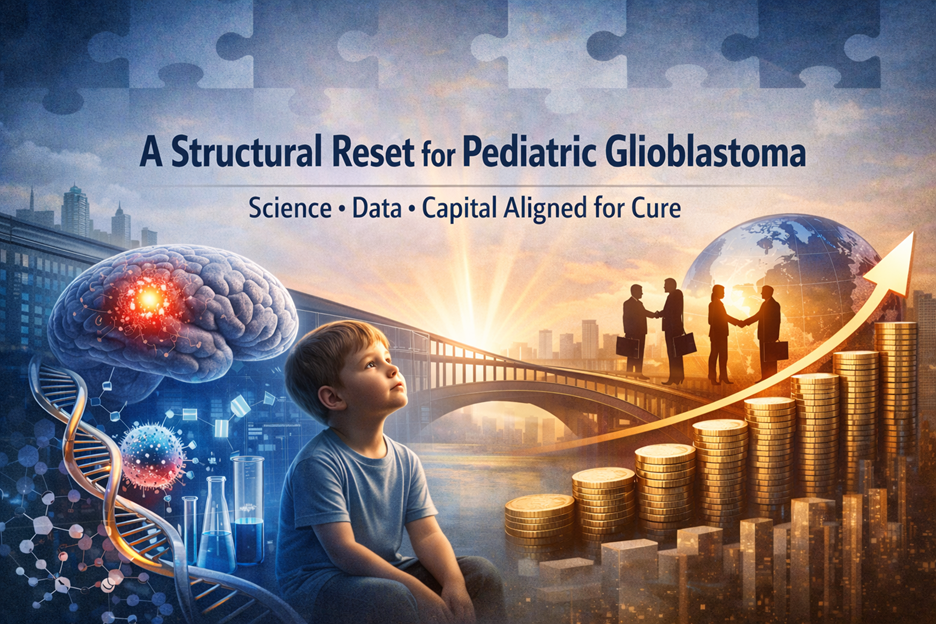
Individually, each recommendation addresses a material weakness in the pediatric brain tumor ecosystem. Together, they form an integrated operating framework—aligning biology, data, and capital around accountability, speed, and measurable patient impact.
This is not a call for refinement. It is a call for reset.
- Replace Escalating Cytotoxicity with Tumor Behavior Modulation
Glioblastoma is not a simple malignancy. It is defined by molecular heterogeneity, intratumoral plasticity, adaptive resistance, immune evasion, and rapid recurrence.
Conventional approaches—dependent on blood–brain barrier–penetrant alkylating agents—deliver modest tumor exposure while imposing profound systemic and neurocognitive toxicity. After four decades of limited durability, continued reliance on highly toxic, low-yield regimens is biologically mismatched to the disease and increasingly difficult to defend.
A more rational strategy is to modulate tumor behavior rather than escalate cytotoxicity.
That includes:
- Immune-based strategies that overcome GBM’s immunosuppressive microenvironment
- Pathway-specific induction of apoptosis targeting dysregulated survival signaling
- Anti-angiogenic approaches disrupting aberrant vascular networks that enable proliferation and invasion
These strategies prioritize specificity, durability, and reduced collateral damage.
Accordingly, Summit RFAs and associated funding eligibility should explicitly require prioritization of nontoxic, behavior-modulating strategies, replacing continued investment in highly toxic legacy regimens.
Scientific rigor demands it. Ethical responsibility requires it.
- Elevate Research Data to Financial-Grade Standards
Breakthrough discovery is increasingly dependent on high-quality, interoperable, and governed data. Yet cancer research data remains fragmented, inconsistently structured, and insufficiently governed.
In financial markets, decisions involving billions of dollars rely on standardized, auditable, board-level-governed data. Cancer research—where the stakes are measured in children’s lives—demands no less.
Research data should meet financial-grade standards across four dimensions:
Completeness & Standardization
Clinical, molecular, imaging, outcome, and longitudinal data must be comprehensive, harmonized, and structured for cross-institutional analysis.
Accuracy & Auditability
Clear provenance, version control, and validation processes must allow independent verification, mirroring financial audit requirements.
Governance & Accountability
Data stewardship must be elevated to board-level oversight with named executive accountability and enforceable controls.
Transparency & Timely Disclosure
Data should be shared responsibly and promptly; delayed or incomplete disclosure distorts decision-making and slows discovery.
Until research data is treated with the same seriousness as financial reporting, the ecosystem will continue to tolerate fragmentation, bias, and preventable delay.
Lives depend on data quality. Governance must reflect that reality.
- Establish Community-Wide Governance of Fundraising and Reserves
Rare diseases operate under constraints of time, patient population, and data scarcity. In that environment, capital efficiency becomes a determinant of survival.
Uncoordinated fundraising and excessive reserve accumulation represent systemic friction—slowing discovery, fragmenting effort, and diluting impact.
To accelerate progress, the pediatric research community should adopt formal governance standards for fundraising and reserve practices, including:
- Transparent fundraising principles aligned with near-term, mission-critical research objectives
- Reasonable, disclosed limits on reserve accumulation
- Regular public reporting on reserves, fundraising efficiency, and deployment toward measurable patient impact
- Incentives that reward rapid and responsible conversion of philanthropic dollars into shared data and therapeutic advancement
Strong governance of fundraising is not restriction—it is discipline. It ensures that every dollar raised moves toward cure, not institutional comfort.
In a field where patients cannot wait and no single institution has sufficient scale to succeed alone; capital must move with urgency.
An Integrated Framework for Cure
Individually, these recommendations address science, data, and capital.
Collectively, they align the system.
- Biology drives therapeutic strategy.
- Data fuels discovery and AI-enabled insight.
- Capital accelerates execution and collaboration.
When one pillar is weak, progress stalls. When all three are governed with rigor and aligned around outcomes, acceleration becomes possible.
Following the Summit, SU2C will issue an RFA and assemble a dedicated Dream Team with the potential to cure malignant gliomas. That effort must be anchored not only in exceptional scientists, but in exceptional standards.
The pediatric brain tumor community does not lack intelligence.
It does not lack commitment.
It does not lack funding.
What it has lacked is structural alignment.
That alignment is achievable.
And now, it is non-negotiable.